

My Child Says “I'm Bad at Math": How to Build Math Confidence at Home and School
"I'm Just Not Good at Math"
You've probably heard it. A child looks at a problem — sometimes before even trying it — and says:
"I'm bad at math."
For a parent or teacher, that sentence can be more worrying than "I don't like math." "I don't like math" is a feeling about a subject. "I'm bad at math" is a belief about oneself. One describes a preference. The other describes an identity.
That distinction is the heart of this post.
Here's the reassuring part: hearing "I'm bad at math" doesn't mean a child actually lacks mathematical ability. More often, it means they hit something difficult and quietly turned that one struggle into a permanent verdict. Maybe a foundational skill is shaky. Maybe a classmate seems faster. Maybe they've had a string of wrong answers with no one pointing out what they got right. Maybe they simply haven't had enough chances yet to notice what they can do.
So the real question isn't "How do I convince my child they're good at math?" It's: how do we help a child replace "I'm bad at math" with "I can learn math"?
1. Stop Believing There Are "Math People"
We inherit things like eye color. Math ability isn't like that.
No invisible line at birth sorts the world into "math people" and "everyone else." Children differ — in experience, in confidence, in the pace at which ideas click, in which strengths they lead with — but mathematical ability itself isn't a fixed category you're born into or locked out of.
This matters because kids absorb the fixed-category idea fast, often from adults who mean well. The moment a child believes math ability is something you either have or don't, every hard problem becomes evidence against themselves.
The more useful — and truer — idea: your child may not know how to do this math yet. That's very different from not being capable of learning it.
2. Be Careful What You Say About Your Own Math Ability
This might be the single highest-leverage habit on this list.
Parents say things like:
"I've never been good at math."
"I'm not a math person either."
"I hated math when I was in school."
"Ask Dad — he's the math person in this family."
These comments are usually meant as sympathy. But a child doesn't always hear sympathy. What they often hear is:
"Mom can't do math, and I take after Mom, so I probably can't either."
Or, worse: "Being bad at math is just who we are."
The good news is this one is completely within your control, starting today. Try swapping the script:
Instead of…
Try…
"I was never good at fractions either."
"Fractions can take some time to click. Let's figure out what part is confusing."
"I'm not a math person."
"I may not know how your teacher taught this, but let's look at it together."
"Math was never my thing."
"I don't remember this one — let's work it out as a team."
Small change in wording. Different message entirely.
3. Start With What Your Child Can Do
A child who believes they're bad at math needs evidence that contradicts that belief — and the fastest place to find it is in what they already know how to do.
So don't start with the gaps. Start with the strengths.
For a younger child, ask:
Can they recognize numbers?
Count objects accurately?
Tell which group has more?
Recognize small quantities without counting (subitizing)?
Make groups of five or ten?
Add small numbers?
Notice patterns?
For an older child, ask:
Can they add whole numbers confidently?
Understand place value?
Use a number line?
Double numbers mentally?
Make tens?
Understand multiplication as groups?
Estimate a reasonable answer?
Then say it out loud: "Look at everything you already know how to do."
This isn't false praise — it's accurate accounting. The goal is for the child to think, "I already know some math. Now we're building on it," instead of starting from zero every single time.
When Your Child Says "I'm Bad at Math," Try This
Don't argue. "You can do this — you just haven't learned it yet."
Get specific. "What part feels hard?"
Find something they know. "You know how to make ten. Let's start there."
Shrink the step. Break the new skill into something smaller.
Ask them to show or explain their thinking.
Stop after a small success. End there — don't push into the next hard thing.
4. Add One Small Word: "Yet"
When a child says any version of:
"I don't understand this."
"I can't do fractions."
"I don't get multiplication."
"I'm not good at math."
Teach them to tack on one word:
Yet.
"I don't understand this yet.""I can't do fractions yet."
That one word turns a permanent verdict into a status update. "This is something I can't do" becomes "This is something I'm still learning."
Adults can model it too. If your child says, "I can't do this," resist the urge to jump straight to "Yes, you can!" Instead, try:
"You can't do it yet. Let's figure out what part you already understand and start there."
That response does two things at once: it acknowledges the real, current struggle, and it reminds the child that today's struggle doesn't predict tomorrow's outcome.
Yet is encouraging — but children also need the skills to back it up. That means finding where their understanding is genuinely solid and building carefully from there.
5. Go Back and Strengthen the Foundation
Math builds. That's what makes it math — and it's also why a shaky foundation can quietly sabotage confidence years later.
A child might say, "I'm terrible at fractions," when the real issue is shaky multiplication. Or "I can't add," when the actual gap is weak number sense.
For younger children, foundational skills include:
Counting accurately
One-to-one correspondence
Number recognition
Subitizing
Comparing quantities
Composing and decomposing numbers
Making five and ten
Addition and subtraction relationships
Place value
For older children:
Place value
Addition/subtraction relationships
Multiplication/Division concepts
Number lines
Estimation
Fraction sense
Understanding why an operation works, not just the steps to do it
Don't let grade level dictate where you start. If an earlier skill is the real source of trouble, go back to it. Backing up isn't failing — sometimes it's exactly how you move forward.
6. Give Them Problems They Can Solve
Children who lack confidence don't necessarily need easier math. They need accessible math with room to think — problems with more than one entry point and more than one way in.
Instead of a single right-answer question:
"7 + 5 = ?"
Try an open question:
"What are some different ways you could make 12?"
Instead of:
"What is 38 + 24?"
Try:
"Two numbers add up to about 60. What might the numbers be?"
For a younger child:
"Show me 8 in as many ways as you can."
They might reach for fingers, counters, dots, or number combinations like 4 + 4, 5 + 3, or 10 – 2. Now the child isn't simply being scored right or wrong. They're doing mathematics — and they can succeed at it.
7. Ask "How Did You Think About It?" More Often
Shift some of the spotlight away from "What's the answer?" and toward:
"How did you figure that out?"
"What did you notice?"
"Could you show me another way?"
"How do you know?"
"Can you draw it or show me with objects?"
This does double duty. It gives the child a chance to be right about something, even inside a wrong final answer — and it gives you a window into what they actually understand. A wrong answer might trace back to one small slip. A correct answer might reveal more sophisticated thinking than you expected.
8. Slow Down: Fast Math Isn't the Same as Good Math
A child watches a classmate blurt out an answer instantly and concludes, "She's good at math. I'm not."
Help separate speed from understanding. Value children who think carefully, notice patterns, use strategies, explain their reasoning, estimate, check whether an answer makes sense, and try a second method when the first one stalls.
Math is about thinking — not winning a race to the answer.
9. Make Mistakes Safe
A child who believes they aren't good at math often becomes afraid to even attempt a problem, because every wrong answer feels like fresh proof: "See? I knew I couldn't do it."
You can change that story. Instead of leading with "No, that's wrong," try:
"Show me what you were thinking."
Then find the part that was right before addressing the part that wasn't:
"You knew you needed to subtract — that's exactly right. Let's look at what happened in this next step."
This builds real confidence, not empty confidence — it never pretends a wrong answer was correct, but it also never lets the mistake erase what the child got right.
10. Use Objects, Pictures, and Games — Even With Older Kids
Manipulatives and visuals aren't just training wheels for young or struggling students — they help learners at every level make sense of ideas that are still abstract on paper.
Practical tools: dice, dominoes, playing cards, coins, counters, ten frames, number lines, base-ten blocks, drawings, and math card games.
Games in particular offer something confidence-building math often lacks: repeated, low-stakes chances to use numbers successfully without feeling like a test. A game like Ten Fish naturally reinforces making ten, number recognition, and addition and subtraction. A game like Absolute Zero builds integer understanding and mental math through repeated, playful reps — no worksheet, no pressure, just numbers in motion.
11. Build Confidence in Small Steps
A simple formula to keep in mind:
Start with success → add a small challenge → practice → celebrate progress → add another challenge.
Not: easy, easy, then suddenly a grade-level worksheet. Not: hard, failure, then more of the same hard problems.
For example, if 8 + 7 feels overwhelming, start with 5 + 5, 5 + 6, 6 + 6. Then move to 6 + 7, 7 + 7, 7 + 8 — and help the child notice the relationships between them:
"You knew 7 + 7 was 14. How could that help you figure out 7 + 8?"
Now the child has a strategy, not just another isolated fact to memorize.
12. Praise the Right Things
Even well-meant praise can quietly reinforce the "fixed ability" myth. "You're so smart!" makes intelligence sound like a trait rather than a process.
Try praising what the child actually did:
"You kept working even when that was tricky."
"That was a clever way to break the number apart."
"You noticed a pattern."
"You knew something wasn't right and checked your answer."
"You didn't know that last week. Look what you can do now."
This kind of praise points to something the child controls — effort, strategy, persistence — rather than something they either have or don't.
Want the quick version? Save this guide for the next time your child says, ‘I’m bad at math.’
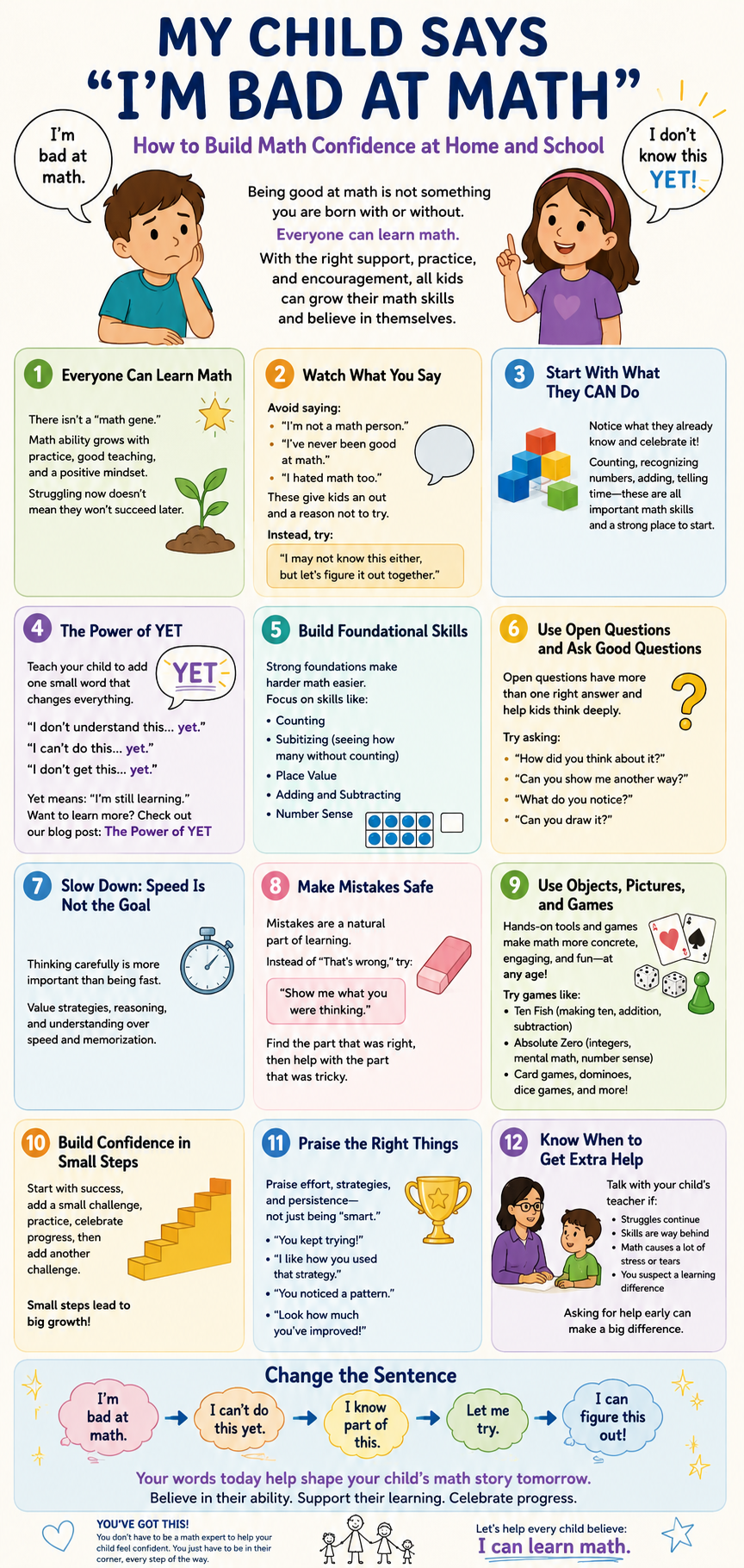
13. Know When "I'm Bad at Math" Really Means "I Need Help"
This isn't a call to just think positively and hope it works out. Sometimes a child genuinely has a learning gap that confidence-building alone won't close.
Talk with the teacher if:
Basic skills remain difficult despite consistent practice
The child can't explain concepts they've been working on for a while
Math consistently causes significant frustration or shutdown
The child is falling further behind, or the teacher is seeing the same struggle
There may be signs of a learning disability such as dyscalculia
Confidence matters — but it grows much faster when it's paired with the right instruction and support.
Change the Sentence
The goal was never to get a child to suddenly announce, "I LOVE MATH!" That's not the finish line.
The real progress looks smaller, and more honest, than that:
"I'm bad at math." → "I can't do this one yet." → "I know part of this." → "Let me try." → "I can figure this out."
That's the sentence we're actually trying to change.