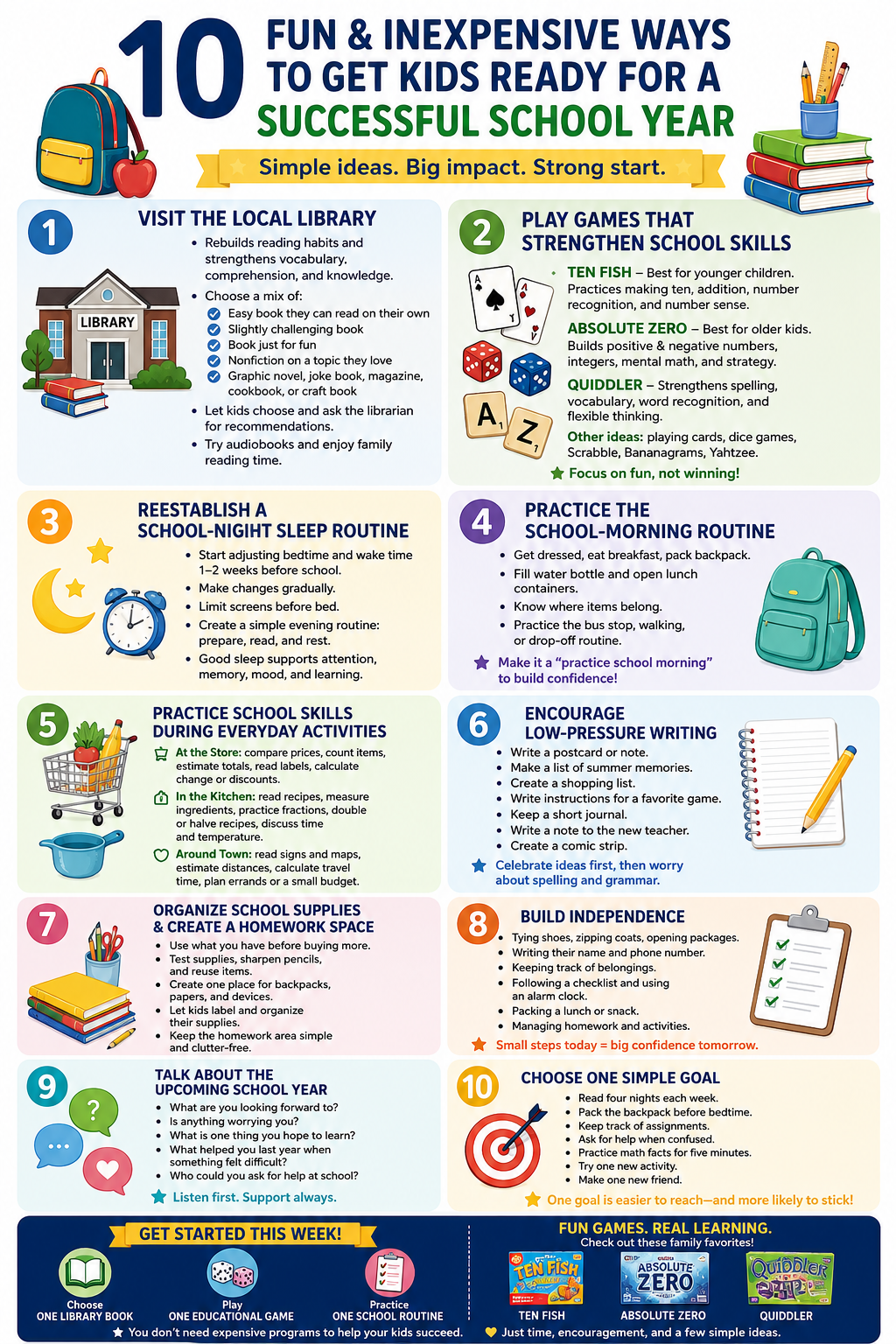

10 Fun and Inexpensive Ways to Get Kids Ready for a Successful School Year
Introduction: Back-to-School Preparation Does Not Have to Be Expensive
Parents do not need costly tutoring programs, workbooks, or supplies to help children prepare for school.
Simple activities can refresh academic skills, rebuild routines, and increase confidence.
The goal is to make learning feel fun and positive, not turn the final weeks of summer into school.
1. Visit the Local Library
Benefits
Rebuilds regular reading habits.
Strengthens vocabulary, comprehension, attention, and background knowledge.
Helps children find topics they are excited to learn about.
What books should children choose?
Encourage children to select:
One easy book they can read independently.
One slightly more challenging book.
One book chosen simply for fun.
One nonfiction book about an interesting topic.
A graphic novel, joke book, magazine, cookbook, or craft book for reluctant readers.
Parent tips
Allow children to make most of their own choices.
Ask the librarian for age-appropriate recommendations.
Try audiobooks during car rides or quiet time.
Set aside a short family reading time without requiring a certain number of pages.
2. Play Games That Strengthen School Skills
Games allow children to practice important skills without worksheets or pressure.
Ten Fish
Best for younger children.
Practices making ten, addition combinations, number recognition, and number sense.
Builds confidence and fluency with basic math facts.
Absolute Zero
Best for older elementary and middle school students.
Practices positive and negative numbers, integers, mental math, and strategic thinking.
Supports skills children will use in middle school math and algebra.
Quiddler
Strengthens spelling, vocabulary, word recognition, and flexible thinking.
Encourages children to experiment with letters and discover new words.
Keep a dictionary nearby and look up unfamiliar words together.
Other inexpensive game ideas
Traditional playing cards for addition, subtraction, multiplication, comparing numbers, and sequencing.
Dice games for mental math and number facts.
Scrabble or Bananagrams for spelling and vocabulary.
Yahtzee for addition, multiplication, and scorekeeping.
Parent reminder
Choose games that match the child’s age and current skill level.
Avoid correcting every mistake.
Focus on enjoyment, conversation, and strategy rather than always winning.
3. Reestablish a School-Night Sleep Routine
Begin adjusting bedtime and wake-up time one or two weeks before school.
Make changes gradually instead of waiting until the night before school starts.
Reduce screens before bedtime.
Create a simple evening routine that includes preparing clothes, packing backpacks, reading, and going to bed at a consistent time.
Explain that sleep supports attention, memory, mood, and learning.
4. Practice the School-Morning Routine
Help children rehearse common school-day tasks:
Getting dressed and ready by a certain time.
Eating breakfast without rushing.
Packing and carrying a backpack.
Filling a water bottle.
Opening lunch containers independently.
Remembering where shoes, backpacks, and school supplies belong.
Reviewing the bus stop, walking, or school drop-off routine.
For younger children, turn this into a playful “practice school morning.”
5. Practice School Skills During Everyday Activities
At the grocery store
Compare prices.
Count items.
Estimate the total.
Read labels.
Calculate change or discounts with older children.
In the kitchen
Read a recipe.
Measure ingredients.
Practice fractions.
Double or halve a recipe.
Discuss time and temperature.
Around town
Read signs and maps.
Estimate distances.
Calculate travel time.
Let older children help plan errands or manage a small budget.
6. Encourage Low-Pressure Writing
Simple writing ideas include:
Write a postcard to a friend or relative.
Make a list of favorite summer memories.
Create a shopping list.
Write instructions for a favorite game.
Keep a short journal.
Write a note to the new teacher.
Create a comic strip.
Encourage parents to respond to the child’s ideas before correcting spelling, grammar, or handwriting.
7. Organize School Supplies and Create a Homework Space
Sort through last year’s supplies before buying anything new.
Test markers, sharpen pencils, and reuse folders or containers.
Create one consistent place for backpacks, papers, and school devices.
Let children label and organize their own supplies.
Set up a simple homework area with only the materials they regularly need.
Remind parents that the space does not need to be expensive or picture-perfect.
8. Build Independence
Depending on the child’s age, practice:
Tying shoes.
Zipping coats and backpacks.
Opening food packages.
Writing a first and last name.
Memorizing a parent’s phone number.
Keeping track of personal belongings.
Following a short checklist.
Using an alarm clock.
Packing a lunch or snack.
Managing homework and activity schedules.
Explain that small responsibilities help children feel more confident and capable.
9. Talk About the Upcoming School Year
Conversation starters may include:
What are you looking forward to?
Is anything worrying you?
What is one thing you hope to learn?
What helped you when something felt difficult last year?
Who could you ask for help at school?
Encourage parents to listen carefully without immediately dismissing concerns or trying to solve every problem.
10. Choose One Simple Goal
Possible goals include:
Read four nights each week.
Pack the backpack before bedtime.
Keep track of assignments.
Ask for help when confused.
Practice math facts for five minutes.
Try one new activity.
Make one new friend.
Recommend choosing one manageable goal rather than creating a long list of expectations.
Conclusion: Keep It Simple and Positive
Children do not need to review an entire year of schoolwork before school begins.
A few enjoyable activities and consistent routines can make a meaningful difference.
Focus on confidence, curiosity, independence, and family connection.